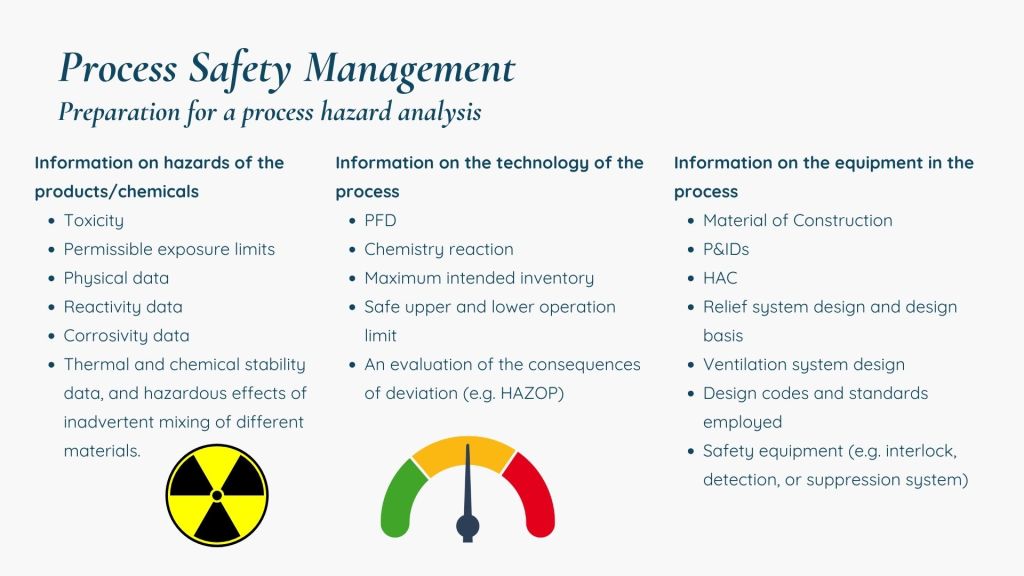
Process Safety Information (PSI) หรือข้อมูลความปลอดภัยของกระบวนการ เป็นข้อมูลเบื้องต้นที่สำคัญมากในกระบวนการผลิต และเป็นข้อมูลพื้นฐานหลัก Fundamental element ในงานการจัดการด้านความปลอดภัยของกระบวนการ หรือ Process Safety Management (PSM) เพราะบอกถึงความรู้ ความเข้าใจ และความตระหนักถึงอันตรายของสารเคมี เทคโนโลยีกระบวนการผลิต อุปกรณ์หรือเครื่องจักรที่เรากำลังทำงานร่วมกับมันอยู่
ดังนั้นแล้วการมีข้อมูลเรื่องที่เกี่ยวกับความปลอดภัยให้รอบด้าน ครบถ้วน ทันสมัยจึงมีความสำคัญมาก
Process Safety Information (PSI) Audit
Process Safety Information (PSI) Audit ซึ่งเป็นหนึ่งในกิรจกรรมหลักของ Process Safety Managemet Audit คือการตรวจสอบ หาจุดไม่เชื่อมโยง Non-Conformity (N/A) เพื่อลดโอกาสการเกิดอันตราย โดยหัวข้อที่ควรตรวจสอบภายใต้ Process Safety Information ได้แก่
Context
หัวข้อที่ควรตรวจสอบ
Audit Criteria
ภาพรวม PSI ที่เอาไปใช้ในการศึกษา PHA
– Date of PHA vs PSI
– Completeness of PSI in PHA เช่น ข้อมูลของอันตรายของสารที่เอามาใช้ในกระบวนการ เทคโนโลยีกระบวนการผลิต เครื่องจักรในกระบวนการผลิต
OSHA PSM 29 CFR 1910.119(d)
ข้อมูลของสารอันตราย
– Material Safety Data Sheet (MSDS) of highly hazardous chemical ว่ามีข้อมูลสำคัญ เช่น Toxicity, Permissible exposure limit, Physical data, Reactivity data เป็นต้น
OSHA PSM 29 CFR 1910.119(d)(1)
ข้อมูลของกระบวนการผลิต
– Date of Process Flow Diagram (PFD) vs Modification
– Maximum inventory in PSI vs PHA
– Availability of set point in all modes
– Written set point vs set-point in DCS
– Availability of consequence if process deviation เช่น HAZOP, QRA
OSHA PSM 29 CFR 1910.119(d)(2)
ข้อมูลของเครื่องจักรในกระบวนการผลิต
– Date of Piping & Instrument Diagram (P&ID) vs Modification
– Flow scheme ของ PFD vs P&IDs
– Site survey the modify process vs P&ID
– Site survey the dissimilar material vs break class in P&ID
– Site survey actual equipment vs Hazardous Area Classification (HAC)
– Selected PSV vs worst case scenario
– Capacity of PSV vs modification
– Design of the disposal system vs modification
– Valve position of the inlet/outlet PSV
– Car seals at the inlet/outlet PSV
– Routing of tailed pipe
– Version of HMB vs modification
– List of Safety Critical Element (SCE)
OSHA PSM 29 CFR 1910.119(d)(3)
ตัวอย่าง Non-Conformity
ตัวอย่างที่ 1
| Observation During document review and field verification of P&ID PID-HYD-001 for the hydrogenation unit, it was observed that a control valve (CV-204), installed in 2023 as part of a process modification, was not reflected in the current version of the P&ID. The field-installed valve was clearly tagged, but the drawing still shows a manual valve. The associated MOC was closed, but no evidence was found to confirm the drawing had been updated accordingly. |
| Finding The P&ID for hydrogenation unit (Document, PID-HYD-001) has not been updated to reflect a new control valve (CV-204) that was installed during modification in 2023. The MOC related to this change was closed, but the P&ID still shows the previous manual valve. According to OSHA PSM 29 CFR 1910.119(d)(3), process safety information must be accurate and reflect the current process condition. |
| Risk Operator may rely on inaccurate drawing, which could lead to incorrect isolation, process control errors, or a safety incident during maintenance or upset conditions. |
| Recommendation Update the P&ID to reflect all recent modifications. Ensure that all MOC-related changes are systematically reviewed and incorporated into PSI document. |
ตัวอย่างที่ 2
| Observation Upon review of the process safety information for hydrogen chloride (HCl), it was found that the available SDS and chemical hazard documentation lacked critical information regarding the reactivity and incompatibility of HCl, such as its violent reaction with water and its corrosive effects on metals. No supplementary technical data was found in the PSI folder, and operations personnel were unaware of these specific hazards. |
| Finding The MSDS/SDS and chemical data sheets for hydrogen chloride (HCl) used in scrubber system are available, but do not include reactivity or incompatibility information, particularly its reaction with water and certain metals. Per OSHA 1910.119(d)(1), information pertaining of the highly hazardous chemicals in the process shall consist of at least, reacivity data, hazardous effects of inadvertent mixing of different materials that could forseenably ocur. |
| Risk During the chemical storage, handling, top-up operation or emergency response, the operator might lack awareness of the hazards posed by hydrogen chloride, which could lead to a safety incident. Additionally, the leak or spill can lead to corrosive material release and damage the secondary containment. |
| Recommendation Review and update the MSDS/SDS for HCl to include all required data. Ensure that SDSs are completed and accessible to relevant personnel, such as field-operator. |
ตัวอย่างที่ 3
| Observation During the review of process design documentation for the reactor pressure relief system, the PSI datasheet (Document ID: PRD-RX-010) shows the set pressure of the relief valve (RV-301) as 12.5 barg. However, inspection and calibration records from the last turnaround show the actual set pressure is 14.0 barg. No MOC was found explaining this change, and the PSI database had not been updated to reflect the current configuration. |
| Finding The conflict between the SP of PSV (RV-301) was 12.5 barg whereas the inspection and calibration record shown 14.0 barg in the last turnarounf without MOC explained this change. According to 29 CFR 1910.119(d)(3), process safety information must be accurate and reflect the current process condition. |
| Risk If the operator mislead the actual SP of they may operate over the maximum allowable of operating pressure of reactor. This will lead to overpressure and potentialy vessel rupture and loss of containment. |
| Recommendation Review and update the SP of RV-301. Ensure the SP is set properly and align with equipment design pressure, and initiate a formal MOC if the change is required. |
 PROcess Safety TASK