Key Factors
Liquid line sizing is the process of determining the appropriate diameter and thickness of a pipeline that is used to transport liquids from one location to another.
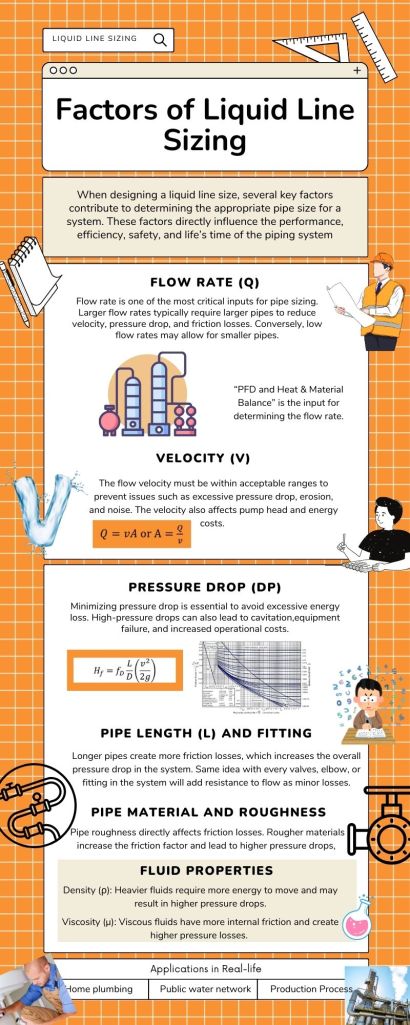
Liquid line sizing is a critical aspect of process engineering design, as it ensures that the correct amount of fluid can be transported safely and efficiently through a pipeline.
The design of liquid pipelines is based on several factors, including the flow rate of the liquid, the pressure drop, the viscosity of the liquid, the density of the liquid, the pipe material and thickness, and the elevation changes in the pipeline. All of these factors must be taken into account when designing a liquid pipeline system.
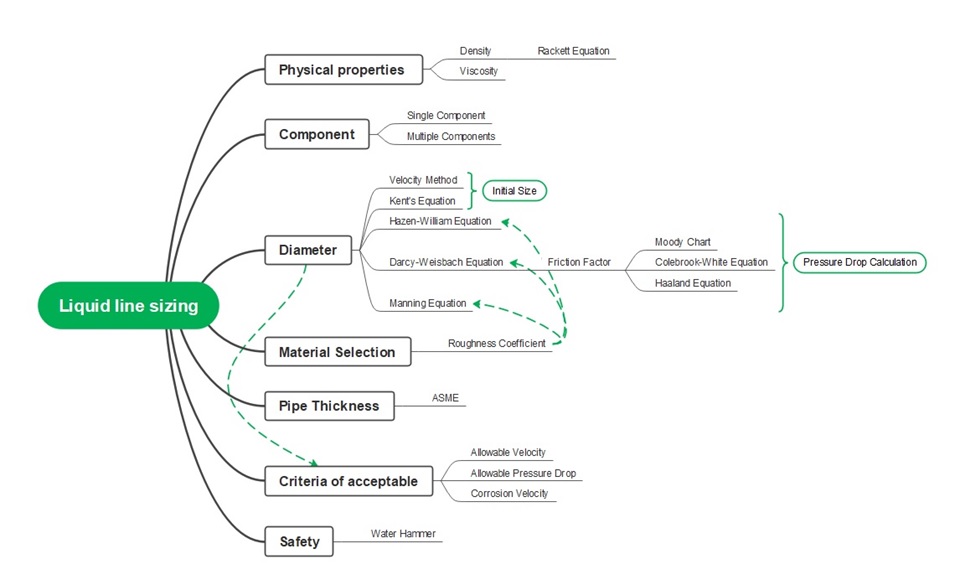
To size a liquid pipeline, you must first determine the required flow rate of the liquid. This can be done using various methods, including mass flow rate, volumetric flow rate, and velocity. Once the required flow rate is determined, you can then use various calculations to determine the appropriate pipe diameter and thickness to minimize pressure drop.
The pressure drop in a liquid pipeline is a critical factor that must be carefully managed. Too much pressure drop can cause excessive friction and reduce the flow rate, while too little pressure drop can cause the liquid to flow too quickly, which can cause damage to the pipeline. You must also take into account the effects of fittings, valves, and other components that can affect the pressure drop in the system.

Flow rate: The rate at which liquid flows through a pipeline, expressed in terms of volumetric flow rate such as cubic meter per hour;
Velocity: The speed at which the liquid flows through the pipeline, expressed in terms of meters per second;
Pressure drop: The decrease in pressure that occurs as the liquid flows through the pipeline due to frictional losses, changes in elevation, and other factor;
Density: The mass of a liquid per unit volume, expressed in terms of kilograms per cubic meter.
Viscosity: The resistance of a liquid to flow, which is determined by its molecular structure and temperature.
Pipe Sizing Calculation Formula and Application
Several methods are used to calculate the appropriate size of a pipe for a given flow rate and pressure drop. Here are some of the most common pipe-sizing calculation methods:
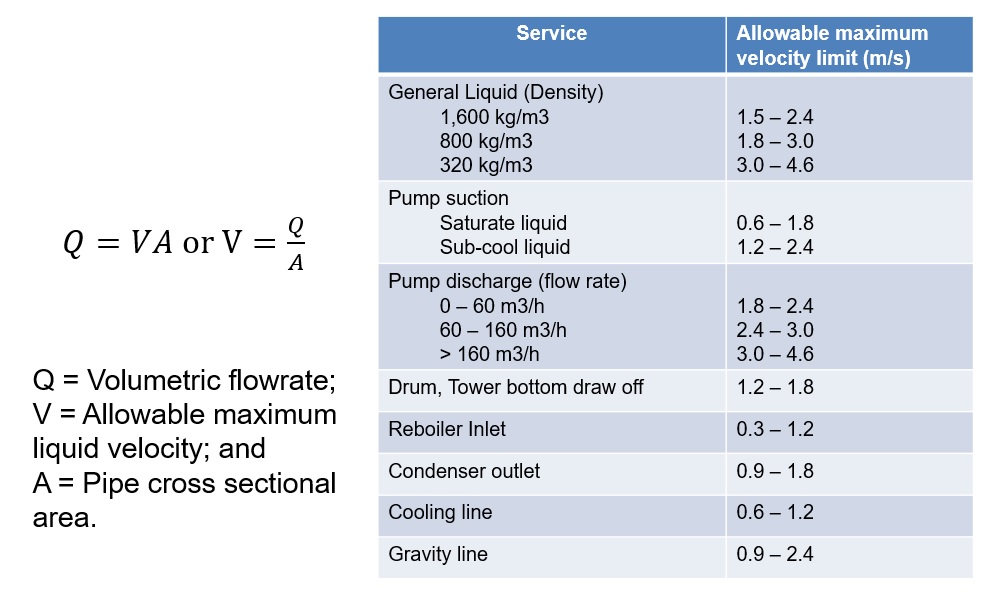
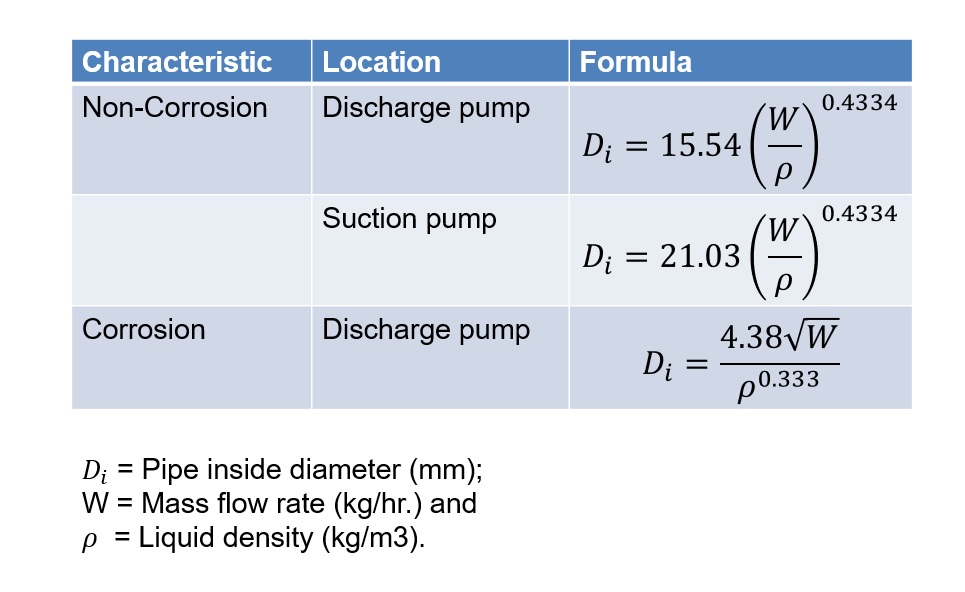
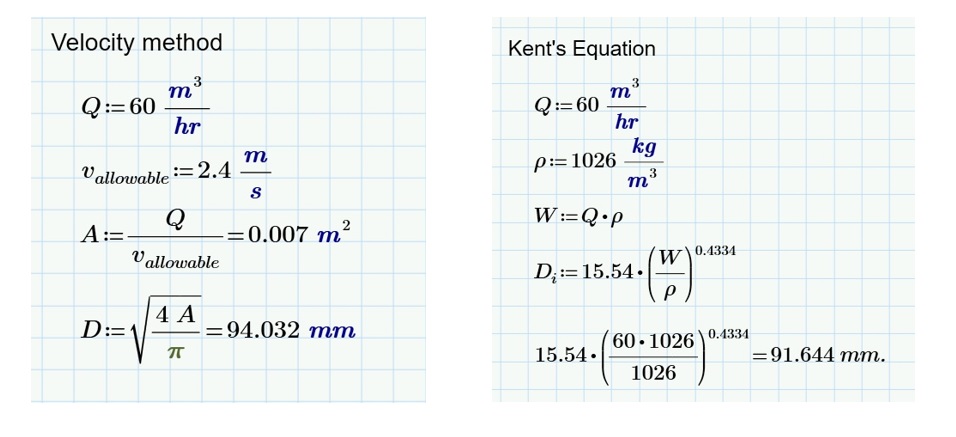
Velocity Method and Kent equation: This method involves calculating the required pipe diameter based on a desired fluid velocity. The recommended velocity range for liquid flow is shown below. This method is relatively simple, but it does not take into account the effect of pressure drop and can result in oversized or undersized pipes.
Example-1
Calculate line size to carry water flow of 60 m3/h temperature 300 degC through a distance of 200 meters.
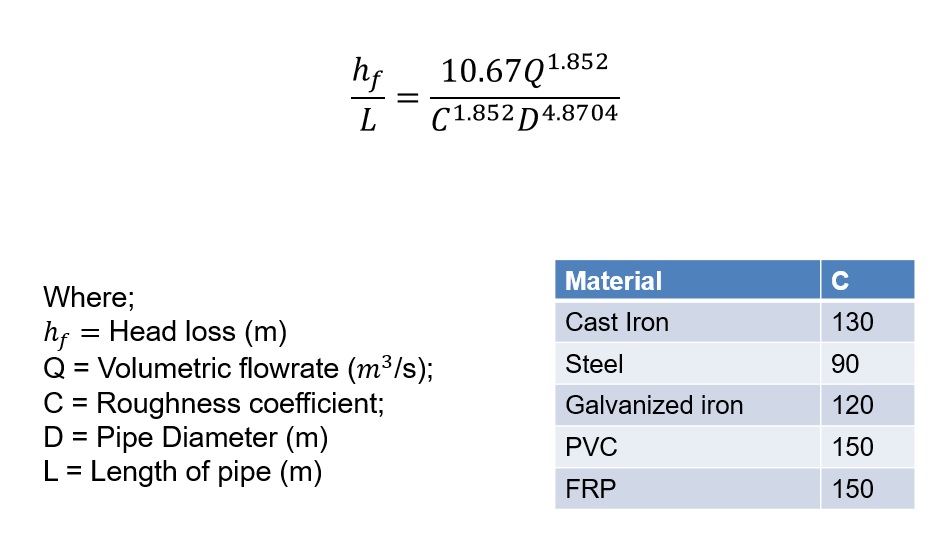
Hazen-Williams Equation: This equation is a semi-empirical formula that relates the flow rate, pipe diameter, and pressure drop for a given fluid and pipe material. It is commonly used for water flow in pipes and is based on experimental data. The Hazen-Williams equation is relatively simple to use, but it has limited applicability for fluids other than water.
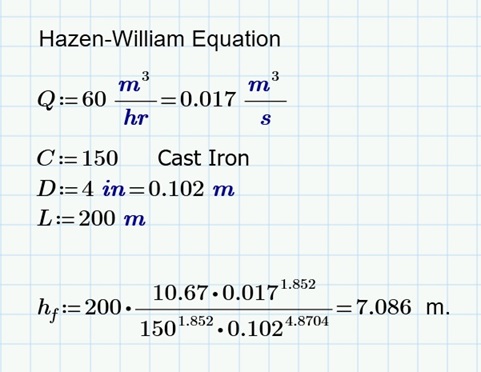
Example-2
Calculate of the pressure of a pipe of 4-inch diameter carrying of water flow of 60m3/h temperature 300 degC through a distance of 200 meters. The pipe material is Cast Iron with an absolute roughness 0.25 mm. by using the Hazen – William Equation.
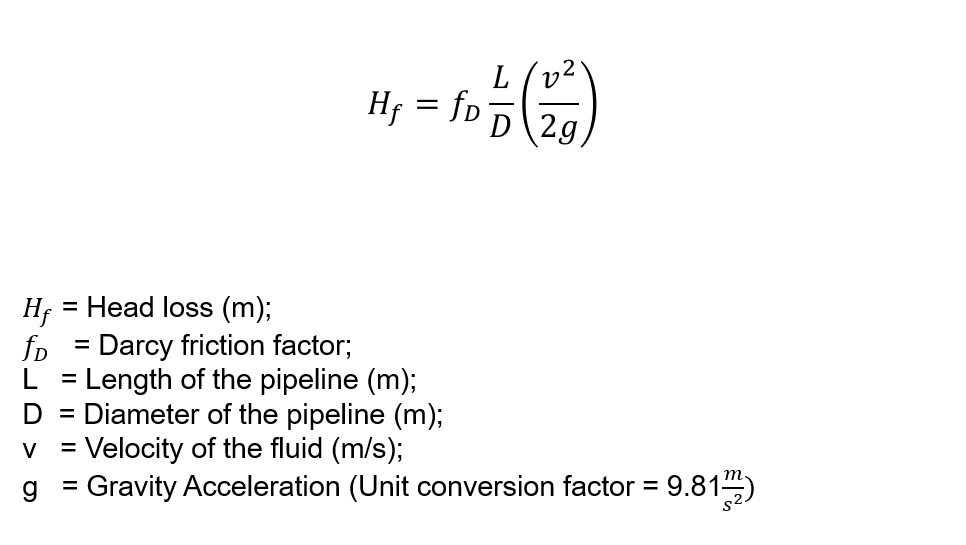
Darcy-Weisbach Equation: This equation is a more general form of the pressure drop method, and it takes into account the effect of fluid velocity, pipe diameter, roughness factor, and other factors. It is widely used in fluid mechanics and is applicable to a wide range of fluids and pipe materials. The Darcy-Weisbach equation is more complex than the Hazen-Williams equation, but it provides more accurate results. The Darcy-Weisbach equation is commonly used for designing water supply-system, oil and gas, and HVAC systems.
Example-3
Calculate of the pressure of a pipe of 4-inch diameter carrying water flow of 60m3/h temperature 300 degC through a distance of 200 meters. The pipe material is Cast Iron with an absolute roughness 0.25 mm. by using the Darcy Equation.

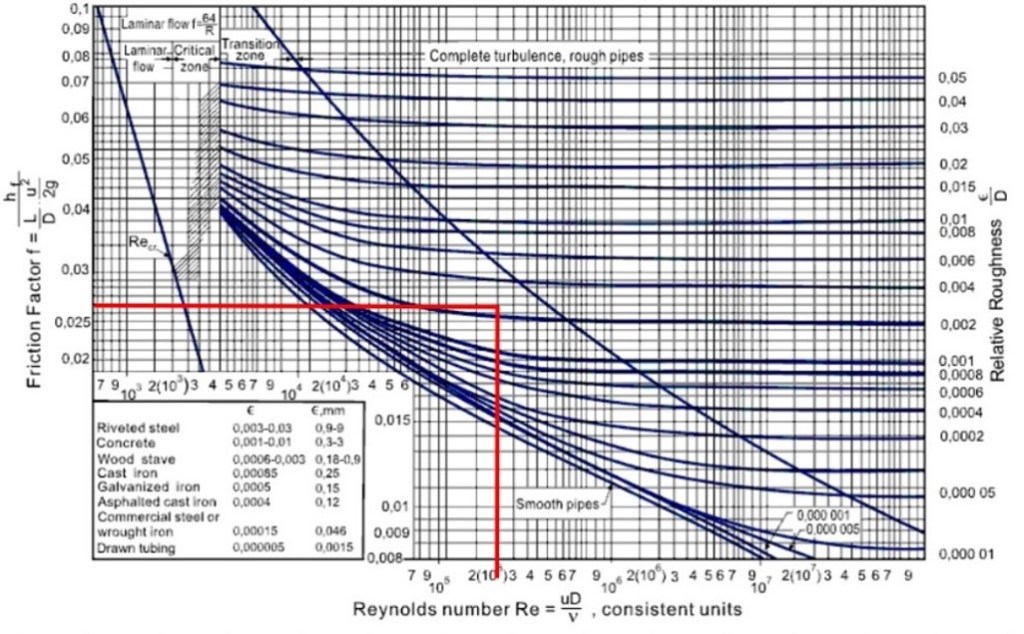
From the Moody chart in the above figure, it can be distinguished into the equations in laminar flow region, equations for smooth pipe turbulent flow, and an equation for completely turbulent flow.
The next formula is a more accurate method than the Moody chart is the Colebrook equation.

However, the Colebrook equation cannot be solved analytically, so it must be solved numerically using iterative methods.
The other equation is the Haaland equation. It is a modified version of the Colebrook equation which is less computationally intensive than the Colebrook equation.
The Manning formula. This equation is commonly used in open channel flow calculations, but it can also be applied to pipe flow as well. The Manning formula takes into account the effect of slope and able to be used if the liquid is not fully enveloped.
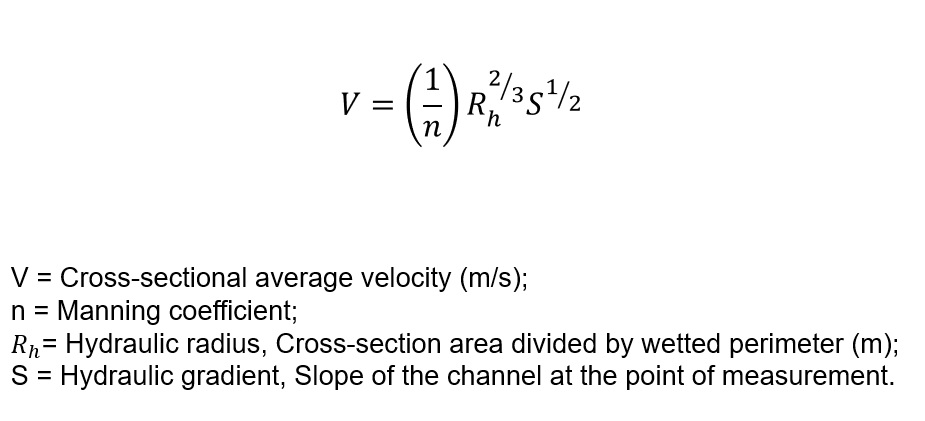
Compare equations
| Equation | Advantage | Disadvantage |
| Darcy and Fanning Equation | Applicable to both laminar and turbulent flow. Accounts for pressure drop. Widely used in engineering practice. | Assumes constant properties and steady-state conditions. Not accurate for flow through noncircular pipes. Requires iterative calculations. |
| Hazen-Williams equation | Simple to use and understand. Applicable for steady-state, turbulent flow in circular pipes. Accounts for friction and diameter changes. | Less accurate than Darcy. Limited to circular pipes with constant diameter. Assumes uniform flow and smooth pipe walls. |
| Manning equation | Accounts for irregular pipe shapes and nonuniform flow. Useful for open-channel flow and gravity-fed systems. Widely used in civil and environmental engineering applications. | Assumes constant roughness coefficient. Less accurate for laminar flow or flow with sudden changes in slope or channel shape. |
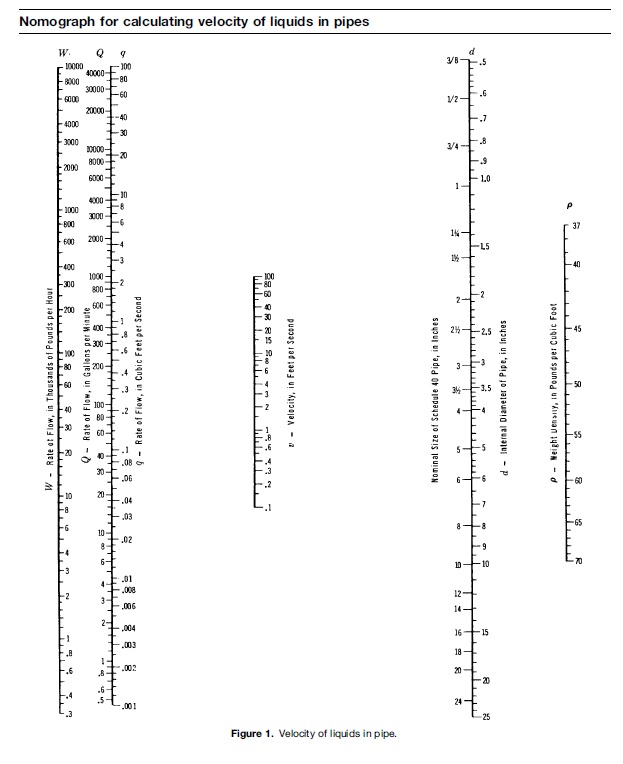
How to estimate the liquid velocity in the bore pipe
บทความนี้จะพูดถึงวิธีอย่างง่ายในการประเมินความเร็วของการไหลในท่อ เพื่อนำไปเทียบกับความเร็วการกัดกร่อน

Service 2
$199
Navigating life’s intricate fabric, choices unfold paths to the extraordinary, demanding creativity, curiosity, and courage for a truly fulfilling journey.
Service 3
$199
Navigating life’s intricate fabric, choices unfold paths to the extraordinary, demanding creativity, curiosity, and courage for a truly fulfilling journey.
 PROcess Safety TASK