Event Tree Analysis (ETA) is a graphical tool used in Quantitative Risk Assessment (QRA) and decision analysis to evaluate the possible outcomes of a series of events. The overviews of how Event Tree Analysis (ETA) are as follows.

- Identification of Initiating Event: The analysis starts with the identification of the initiating event (IE), which is the initial incident or condition that triggers the analysis such as LPG cylinder failure and LPG gas leakage.
- Branching Events: From the initial event, the analyst develops a tree-like structure, with branches representing different possible outcomes or scenarios. Each branch represents a Possible Event (PE) or decision that may follow the initial event such as detected by the gas detector.
- Probabilities: Along each branch, probabilities are assigned to different events or decisions
- Endpoint: The analysis culminates in endpoints, which are the final outcomes or consequence outcomes of the event.

Example

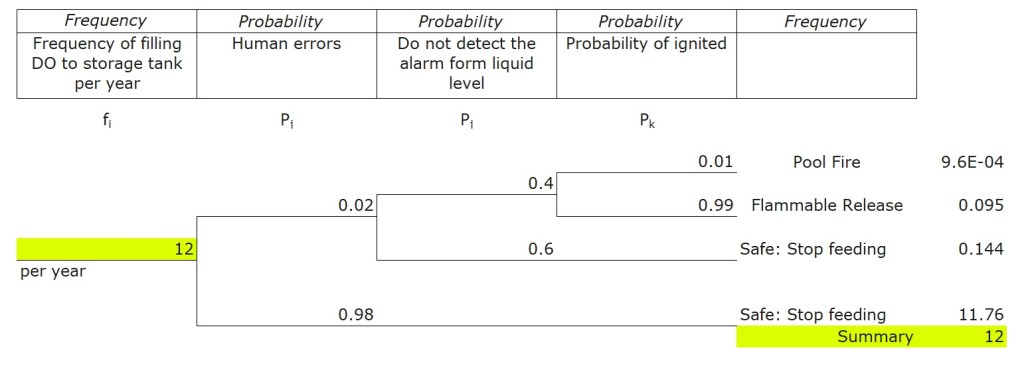
A Diesel Oil (DO) tanker pumps excessive DO material to a storage tank than the available capacity due to the malfunction of level monitoring resulting in overfilling and releasing material to the working area via the venting system. This can lead to pool fire if ignited.
Based on the record, the frequency of refilling the DO is once per month, and due to the orientation training provided to the driver before performing the activities, the potential of human error to omit the liquid level during filling is 0.02. The potential that the driver will not detect a high-level alarm is 0.4. The potential of liquid pool fire is estimated at 0.01. The calculation of all the outcomes is as follows.
Compare between ETA and FTA
Event Tree Analysis (ETA) is often used in conjunction with Fault Tree Analysis (FTA), another technique in risk assessment. While FTA starts with an undesired event and traces back to its root causes, ETA starts with an initiating event and explores the possible outcomes and consequences.
 PROcess Safety TASK